
Why Knowledge Management is NOT the Answer
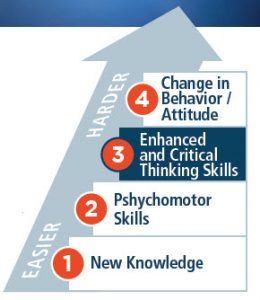
4 Levels of Learning Outcomes
According to Wikipedia, Knowledge Management (KM) is the process of creating, sharing, using and managing the knowledge and information of an organization.
At first-read this sounds like a great idea, and many organizations have spent many millions of dollars in the last 20 years to collect and catalog the knowledge their employees possess, in order to "preserve" it and share it.
There is one glaring problem with this approach - knowing what you know and knowing how you arrived at the answer are worlds apart. As the illustration shows us, knowledge is at the lowest level of learning. Indeed it is the foundation upon which all learning, skill and ability is built, but having knowledge alone is not enough.
For individuals and organizations to have success, there needs to be a transfer of thinking skills- not just information. For example, in one organization we've worked with, the transfer of thinking skills started with asking senior associates to write a short synopsis of the six "defining moments" of their career - when did they have an “ah-ha” moment and how did it change how they worked? These were then categorized in to themes such as loss, growth, conflict, strategy, competitive advantage, etc.
The same senior associates were then interviewed to get more detail about their "stories" - what they had learned and how. Questions such as, "Was there a single factor that influenced your _____," or "If you had the opportunity to give advice to your younger self, what would you advise?"
Finally, the "best" stories in each category (loss, growth, etc.) were chosen and those same senior associates were interviewed, on camera, a'la 60 Minutes, to tell their story in five minutes or less. The previous steps of writing the story out and thinking aloud through interviews helped the associates to succinctly transmit the situation, the outcome and the lessons learned.
In just under two months the organization captured the best thinking from the most experienced people in the organization. The videos were used as "teasers" to get learners interested in the topic (theme) and the other stories were made available in a case study format for learner's reference.
The collection of thinking is available to be disseminated via multiple modalities - on the company's intranet, via a monthly internal newsletter, on-demand from the learning portal, and in leadership training offerings.
An interesting outcome of the project is that other associates have come forward to voluntarily share their thinking as well. They want to share their career defining moments and learnings with the organization and other associates. The organization now has an archive of what, why, and how, rather than a collection of simply what.
Invest in Critical Thinking = HUGE ROI

Some organizations still believe training is a cost-center rather than a money maker.
But the right training, applied at the right time, can have exponential returns! According to this short report on Critical Thinking, published by Pearson in 2013, the return on investment for critical thinking tends to be extremely high. Research has shown that when training moves a $60,000 a year manager or professional from “average" to "superior," the ROI is $28,000 annually. (emphasis, ours) 4
How would your organization like to make $28,000 per year, on each of its managers? We can help. It's what we do.
Smart Pills - Is it Possible to Enhance Your Thinking?

are smart pills real?
Thinking - like any skill - requires practice to improve... right? What if there was a way to make yourself smarter with no effort? What if you could just pop a pill to increase cognition?
The smart pill idea was introduced to the mainstream by the movie Limitless in 2011 (and subsequently a TV show by the same name in 2015).In the movie the main character, Edward Morra, is able to become hyper-focused, productive and perceptive through the use of a nootropic drug called NZT-48. He is able to write a book in four days, make rationale and spot-on stock picks and more.
Believe it or not, there is some truth to this. Many ADD / ADHD medications are considered smart pills - not because they make people smart(er) but because they can help people to focus and concentrate - thereby being better able to take-in and process information. Just as a computer enhances efficiency by helping you to create and store information, a smart pill can increase mental efficiency and abilities.
The most commonly used smart pill in the US is Modafinil - which is used off-label for increased wakefulness and focus. The original purpose of the drug is to solve narcolepsy and certain types of sleep apnea. A 2008 article by TechCrunch founder Michael Arrington dubbed it an entrepreneur's "drug of choice" as opposed to illicit drugs which might cause addiction (Modafinil has no side effects and is not habit forming), although he does question the wisdom of staying up 20 hours straight.
It Works
In addition to anecdotal evidence that nootropics work, a meta-analysis of 24 studies was conducted jointly by researchers at Harvard Medical School and Oxford, which showed that Modafinil does indeed increase cognition. What's interesting is that the most benefits are derived in relation to complex tasks such as planning and decision making - as opposed to simpler tasks such as pressing the right button at the right time. Given today's business environment, which requires quick and complex thinking tasks - Modifinil might be the next required "tool" in a company's toolbox.
Increased Focus Isn't Always the Best Outcome
The Harvard / Oxford study also cautioned that focused thinking is not always the desired outcome. There is evidence that divergent thinking is inhibited by the drug, so jobs and tasks that demand creativity and innovation may suffer.
Do Smart Pills Create an Ethical Dilemma?
The use of smart pills poses some questions for the workplace, such as: should stimulant use be banned or approved? We do allow caffeine and nicotine which have similar effects. How do we differentiate or draw the line for a drug such as Modafinil?
The TechCrunch article joked that venture capitalists might require business owners to take the drug, to ensure their investment / company success. Some colleges are already banning the use of these drugs (Duke University has revised its policy on drug-use to include banning "unauthorized use of prescription medicine to enhance academic performance"); but other "smart drugs" include Ritalin (which increases memory and retention) and Adderall, so aren't schools then penalizing young people who need these medications? (Note: The percentage of young adults prescribed ADD / ADHD medication nearly doubled between 2008 and 2013.)
Research suggests that cognition-enhancing drugs offer the greatest performance boost among individuals with low-to-average intelligence (Scientific American March 1, 2016). So banning the drugs could harm both those who need it and those who could most benefit from it.
We ask these questions because this is where the discussion is happening right now, but give it a few years and we'll be having these same discussions in the workplace - either because everyone will be looking for an advantage in order to get ahead, or because the youth who have relied on these medications for success in childhood will graduate to working in business and may still be taking these cognitive enhancers.
Bottom Line
The bottom line is - smart pills don't increase the size of your brain or the number of neurotransmitters, or make you able to learn something you aren't inherently able to learn in the first place. They simply help you to focus for longer periods of time, thereby increasing your abilities related to complex cognitive tasks.
When it comes to learning, one millennial cautions: While smart drugs allow for instant improvement, they overlook what can be learned from the process of improving. Here here!
Would Your Employees Train on Their Own Time?
"The company has to look forward and transform. If it doesn’t, mark my words, in 3 years we'll be managing decline." [2016] Randall Stevenson, CEO of AT+T

AT+T has been swimming upstream for 20+ years now.
Long gone are the times of one landline in everyone's home. In order to survive, the company has adapted to, embraced, and conquered cellular networks, cable television, fiber optic networks, satellite networks and streaming networks - all on a national scale.
In order to keep up with the rapid changes in technology and infrastructure, their employees have had to constantly change, adapt and grow as well.
Is your company forward-thinking enough to do what AT+T has done?
Between 2013 and 2016 AT+T spent $250 million on employee education and professional development programs. According to Stevenson, the CEO, employees are expected to put in 5 - 10 hours a week in professional development - on their own time. The company pays for or supports their educational efforts but does not directly supply all the training that is needed.
Additionally, the company created their own masters program in conjunction with GA Tech; and then opened it up to the public via Udacity. There were two reasons for this . 1) they couldn't find enough people graduating with the skills that they needed to fill the positions they had open - so they had to create a bigger supply somehow, and 2) Any member of the "public" who enrolls is a potential (well educated) future employee - so they are building a pipeline of skilled employees.
Now THAT's a future-thinking organization.
How Apprenticeships and Teaching Thinking go Hand-in-Hand

If I were to ask you to picture a cell phone - would you picture a baseball sized item, battleship grey, with a silver antenna you had to pull out of the top? Of course not. That is a cell phone of yesteryear.
Yet, when we mention the word "apprenticeship" to organizations or individuals, the most frequent reaction is, "Oh, that's not for us/me; apprenticeships are for manufacturing, hands-on labor, blue-collar jobs."
Not so! Those are apprenticeships of yesteryear.
Welcome to the new era of apprenticeships - they just might save your organization.
On June 29th President Trump signed an Executive Order - Apprenticeship and Workforce of Tomorrow - to expand apprenticeships in the US. The goal is 5 million apprenticeships in the next 5 years (currently there are 450,000 registered apprenticeships in America).
It shall be the policy of the Federal Government to provide more affordable pathways to secure, high paying jobs by promoting apprenticeships and effective workforce development programs.
According to the Department of Labor, companies in all sectors of the American economy are facing complex workforce challenges and increasingly competitive domestic and global markets. Apprenticeships are one key to helping people who have been left behind by shifts in the economy and how work is done.
The Success of Apprenticeships
Apprenticeships are a standard route to a career in much of Europe. Germany, especially, is known for its exceptional apprenticeship model. In Germany, half of high school graduates choose a track that combines training on-the-job with further education at a vocational institution (as opposed to the US, in which less than 5% of young people participate in apprenticeship programs). The mainstream nature of apprenticeships in Germany contributes to the country having the lowest youth unemployment rate in Europe.
Apprenticeships are an acceptable and highly respected alternative to college. At the John Deere plant in Mannheim, over 3,000 young people a year vie for 60 apprentice spots; likewise, at Deutsche Bank in Frankfurt, over 22,000 applicants vie for just 425 places.
Another benefit that Germany reaps from its well-seasoned apprenticeship program is keeping manufacturing jobs in the country. However, apprenticeships are no longer focused solely on manufacturing or "trades." Apprenticeships are now common in IT, banking, hospitality, and healthcare.
In the future, there will be robots to turn the screws. We don't need workers for that. What we need are people who can solve problems - skilled, thoughtful, self-reliant employees who understand company goals and methods. (German educator)
Perhaps it won't work in America
There are a number of reasons why apprentice programs may not work in America, unfortunately. Naysayers cite costs, stigma, cooperation, changing belief systems, and turning a big ship around. In short, it's not going to be quick, and it's not going to be easy.
In the United States there is a tendency toward higher education as the path to career options, although a recent article in the Chronicle of Higher Education admits "something about the path from college to career is not working for many people. “In recent decades we've seen corporate America severely reduce the budgets of training departments and cut back the hours allotted for training, per individual. The cost of apprenticeship programs is largely borne by the employer (German companies say their costs range from $25,000 to $80,000 per apprentice) and take two to six years to complete.
One program, at a Siemens plant here in the US (Charlotte NC), reportedly spends $170,000 per apprentice. Cost should be seen as an investment, say German proponents. Rather than looking for immediate ROI, companies need to look to longer-term benefits such as a ready and able talent pool, long-term employees (studies have shown that apprentices stay with the company that trained them - a loyalty is established), and workers who understand their organization's culture and goals. Additionally, there is a social component - skilling individuals for blue-collar, white-collar, and jobs of-the-future is one of the best ways to cure income inequality.
Americans aren't simply going to jettison old attitudes and decide, for example, that long-term gains, however broad, should trump short-term ROI.
Unlike in Europe, where apprenticeships are integrated into the educational system (in Switzerland students are introduced to apprenticeships as early as fourth grade and Swiss high schoolers are ready to work upon graduation, having started their apprenticeships around age 15).
The minimal apprenticeship programs currently available in the US are "marginalized and have almost no connection, or very limited or tenuous connections, to either our secondary-education or our higher-education systems," says Mary Alice McCarthy, who directs the Center on Education and Skills at the think tank New America.
Despite these perceived drawbacks and challenges, the Department of Labor is ready to help those organizations that do want to begin apprenticeship programs.
The Benefits of Apprenticeship Programs
First, the benefits to individuals: The benefit most widely touted is "college without debt." Apprenticeships always include some form of higher education; sometimes the ratio is 1:1 (equal amounts of time in the classroom and on the job) and sometimes the proportion varies one way or the other. Many apprenticeships culminate in a two-year degree, but the length of time to achieve it may not be exactly two years. If one is enrolled in an apprenticeship, the employer pays for most, if not all, of the tuition with the associated college. Generally employers partner with local colleges (such as community or technical colleges).
Another individual benefit is "earn while you learn." All internships are paid positions. The apprentice does not make the same wages as a fully qualified individual in the role, but that is offset by the amount of tuition they are the beneficiary of. Also, once the apprenticeship is completed, the individual's compensation usually rises substantially.
Other advantages include having a "foot in the door," having re-marketable skills (although, as cited earlier, most apprentices stay with the employer that trained them), and a work-record that aligns with their degree (as opposed to most college graduates who have a degree but no real-world work experience).
Likewise, there are substantial benefits to the employer: One of the most attractive benefits of instituting an apprenticeship program is the ability to "grow your own." Even if companies can find qualified individuals in the general population, oftentimes they come with abilities that don't mesh with the new employer.
For example, the Dartmouth-Hitchcock health system in Lebanon NH runs a 15-month long apprenticeship program to train medical coders, pharmacy techs, and medical assistants. The program was instituted to fight the constant battle of trying to find appropriately skilled individuals in the local area, but the health system's director of workforce development also cited the challenge of hiring workers from other hospitals in the area who "often don't have the same level of competence."
An apprenticeship program also ensures a steady-stream of skilled individuals for the key roles an organization has identified. Rather than trying to beg, borrow or steal already trained employees from other organizations (which doesn't ensure the "ideal" candidate and can cost tens-of-thousands of dollars in recruiting, interviewing and onboarding costs) an employer knows the quality and capability of the apprentices in their pipeline. Apprentice programs quell the panic of "where will we find xxx?"
Apprentices have also been "schooled" in the company culture, work-ethic, values, processes, etc. Many employers cite these intangibles as "invaluable." For instance, at Bosch, a manufacturing organization with facilities in Germany, as well as South Carolina, US, a mistake on the factory floor can potentially cost a million dollars; the director of the apprenticeship program says that the company is confident in the skills as well as the level of responsibility their apprentices have when on the job. In many ways apprenticeships offer a substantial return on investment.
Apprenticeships are no longer limited to manufacturing or construction, as in the past. Today's apprenticeships prepare individuals for careers in healthcare, IT, financial services, insurance and more. In fact, instructional design would make an ideal apprenticeship topic because it is a nuanced skill with much theory to know and practice required to master.
Finally, the Department of Labor is ready with grants and support to help organizations begin apprenticeship programs. The DOL cites benefits such as attracting a new and more diverse talent pool, investing in talent that keeps pace with industry advances, and closing gaps in workers' skills and credentials which undermine productivity and profitability.
Apprenticeship Programs Align with Teaching Thinking Skills
Many of the approaches and benefits of apprenticeships are also built in to a teaching thinking curriculum.
The extended timeline for learning (years, not days or hours), the on-the-job experience and practicality, the incorporation of coaches or mentors, teaching soft-skills such as teamwork and self-management, the structured nature of the learning process which ensures that all participants are learning the same skills in the same order and on the same timetable, the focus on white-collar jobs, and more.
Soft skills are actually better taught in a business environment than they are in a classroom. In a classroom the consequences are very different.
How to Get Started
If your organization would like to explore the possibilities of an apprenticeship program, call us, or go to the Department of Labor web page for resources such as a Quick-Start Toolkit, a list of tax incentives and credits, and information on how to access federal funding to build your program and / or pay stipends to your learners.
Where do Attorneys Come From?

If you work for a large enough organization, you undoubtedly have a law department.
Have you ever wondered where the attorneys come from? Not straight from law school, that's for sure. Your organization acquired them from somewhere else - usually from a law firm.
Law firms are in an unenviable situation. First, they must deploy employee training from day one - law school does not make one an attorney, it simply teaches one about the law. Second, the average tenure at a law firm is 5.4 years. And, most lawyers who leave their firms do not go to another firm - they usually go to corporate America.
So, you're welcome. Law firms are footing the bill for you to the tune of $200,000 per attorney according to our source.
What roles would you train for - from scratch - in your organization? What jobs does the organization prioritize? How does your company stay in business - who are you dependent on? How much is your company willing to invest to "grow" a stellar employee? See this related article for some ideas on how to training employees from the ground up.
Do YOU Have 30 Years to Wait to Develop Leaders at Your Company?
Organizational Development research tells us that it takes 30 years of on-the-job experience for someone to acquire enough well-rounded skills to be a successful leader. In addition to on-the-job experience, it is important to have experience in numerous areas of business. Hence time on-the-job + exposure to many areas of business = a C-level individual with the perspective needed to run an organization. But thirty years? Who has that kind of time?
Here are a few profiles of organizational leaders who have been on that 30 year journey:
Mary Barra, Chairman and CEO of General Motors
Prior to becoming the CEO, Barra worked in product development, purchasing and supply chain, human resources, global manufacturing engineering, as a plant manager, and in several engineering and staff positions. She joined GM in 1980 and spent her entire career (30+ years) at the company.
Doug McMillon, CEO of Walmart
McMillan joined Walmart as a teenage warehouse worker (in 1984) at a local store. He rose through the ranks, working as a buyer, in various levels of store management, and eventually headed up Sam's Club and Walmart's international operations (operating in 26 countries outside of the US).
Ginni Rometty, Chairman, President and CEO, IBM
Prior to being promoted to CEO, Rometty held senior-level positions in sales, marketing and strategy. She began her career at IBM in 1981 as a systems engineer and worked in IBM Consulting as well.
Not everyone has to be a "lifer" within an organization, however. Generalized business experience is helpful as well.
Kenneth Frazier, CEO of Merck & Co.
Frazier spent 20 years as a trial attorney - spending numerous summers teaching trail advocacy in South Africa - before joining Merck as counsel in the public affairs division in 1992. From 2007 to 2011 he led the Human Health division of Merck, before being named President in 2011 and then CEO in 2014.
The most prominent trait of these CEOs (and undoubtedly thousands of others) is the variety of roles and functions within which they worked (and learned). In fact, two separate articles by Forbes in 2015 and the NY Times in 2016, point out the "path to CEO" is dependent on well-rounded experience and experience in many functional areas.
This is an approach that corporate education could support, but rarely does. We tend to "silo" people in to a role or function and encourage them to become a specialist; concentrating all of their experience in that specialist area.
From the NY Times article:
Marc Andreessen, the prominent venture capitalist, has gone so far as to call [well-rounded experience] the "secret formula to becoming a C.E.O." The most successful corporate leaders, he wrote, "are almost never the best product visionaries, or the best salespeople, or the best marketing people, or the best finance people, or even the best managers, but they are top 25 percent in some set of those skills, and then all of a sudden they're qualified to actually run something important."
We Don't Have That Kind of Time
Unfortunately, we don't have 30 years to get our next generation of leaders ready. In order for our companies to remain vital 15 to 20 years from now (when the Boomers, with the most work-experience are all gone) we need a way to accelerate that well-rounded learning. T
he Training Doctor's Thinking Curriculum has one such answer. The customized curriculum is designed to facilitate the very things that make a C-suite leader: a variety of functional experiences, an understanding of finance and strategy, being able to synthesis information about unfamiliar situations, networking and making connections, and more (these attributes were identified in a 2016 study of 459,000 executive profiles via LinkedIn). The best part of The Training Doctor's Thinking Curriculum is that it allows an organization to "bring up" leaders from within the organization which is often critical in terms of historical knowledge and cultural fit.
A recent publication from DDI, titled High-Resolution Leadership, highlights both the length of time it takes to develop leadership skills, as well as the need to accelerate the process:
"Business has hastened the pace of leaders being thrust into roles of increasing scope and responsibility, ready or not. Too often this leads to a mass "arrival of the unprepared" into more complex and perilous higher-level roles where stakeholder scrutiny and the cost of failure are exponentially higher. Leadership is a discipline. Improvement requires learning, practice and feedback - lots of each. But generic skill development won't provide the capability you need for your business. Any efforts you make to accelerate the growth of leaders should train them to apply newly learned skills to the specific challenges and needs that your organization faces now and will face in the near future."
It's folly to focus solely on leadership development, however. It's in every organization's best interest to build the skills of everyone in the organization. What organization can say they don't need people who understand strategy, problem solving, risk management, or decision making? What organizations would rather get-by with employees who don't have self- management skills (as Uber's CEO Travis Kalanik recently demonstrated) or who don't embrace ethics, teaming, or continuous improvement?
Every organization and every individual can benefit when everyone's business-acumen is enhanced. Learn more here or give us a call to see what your customized curriculum might look like.
Why the Ice Bucket Challenge is a Great Example of a Lack of Thinking Skills - but an awesome fundraiser!

Do you remember the "ice bucket challenge" of a few years ago? It was a fundraiser of the ALS Association. ALS is also referred to as Lou Gehrig's disease.
In case you are not familiar - the challenge was to dump a bucket of ice water over your head (or have someone do it for you) OR make a donation to the ALS Association.
One of our colleagues uses his Ice Bucket Challenge experience to illustrate the lack of thinking skills prevalent in society: His children challenged him, via social media, to take the challenge. Seeing the bigger picture, and not really wishing to be drenched in ice cold water, AND due to the fact that he had had a family member die of ALS, he chose option B - making a donation to the ALS Association. His children (who were adults, by the way) were FURIOUS that he didn't "do it." He explained to each of them that the challenge offered two options and that he actually made a bigger impact by making a donation to the cause rather than just a silly video. No matter. To this day they rib him about not being brave enough to take the ice bucket challenge.
What thinking skills do you see as lacking in this scenario? Here's what we see:
Inability to see the "big picture"
Not understanding the purpose of a request - but going along with it anyway
Group think
Choosing to ignore facts that don't "suit" you
Not asking about or looking for alternate "solutions"
Not looking for (or understanding) long-term ramifications
When working with your learners - the above bullets can be used as great discussion starters for any topic. Just pause. Look at the big picture. Seek alternatives. Think individually. Is this a solution for "right now" or more long term? What are the options? What is the best option?
= = = = = = =
Facts about the Ice Bucket Challenge
17 million people doused themselves with cold water; 2.4 million people posted videos of themselves on Facebook
2.5 million people donated money to the cause during the challenge; close to 1 million made no subsequent donations
$115 million dollars was donated to the ALS Association in 8 weeks!
The year prior to the ice bucket challenge the ALS Association received $19.4 million in donations
People who chose the ice water over a donation were referred to as "slacktivists" or arm-chair activists
The success of the ice bucket challenge caused the Muscular Dystrophy Association to end its annual telethon fundraiser citing its need to "rethink how it connects with the public"
One death was attributed to the challenge
The Ice Bucket Challenge has become an annual "event" held in Aug - so get your video camera's ready (or, preferably, your checkbooks)
How to Build a Better Leader

While we often repeat Malcolm Gladwell's premise, in Outliers, that it takes 10,000 hours to be an expert at something, we rarely apply that idea to soft skills - like leadership. And that is quite possibly why we have such a tough time cultivating leaders in our organizations.
Joshua Spodek, author of the bestselling Leadership Step by Step: Become the Person Others Follow likens leadership skills to athletic or acting skills. You must participate, you must start small and perfect different aspects of the craft, you must put yourself in situations beyond your comfort zone to really explore and understand your capabilities. You aren't simply "gifted" the title (or skill) of leader.
Tom Brady recently led his team to a 5th Super Bowl win. But he didn't join the Patriots as a leader. In fact, he was a sixth-round draft pick (the 199th player to be picked!) and, when he joined the team, he was one of four quarterbacks (that's two too many by most NFL team standards). Luckily, Brady was able to hone his skills (both athletic and leadership) while out of the spotlight - the rest is history.
Jennifer Lawrence is the highest paid female actress. It seems as though she just exploded on the scene but in fact she started her "career" in school musicals and church plays. Her first time onscreen was in a supporting role 10 years ago. She's acted in dramas, comedies and sci-fi movies. She has been the lead...and part of an ensemble. She has honed her craft and is viewed as a bankable star in Hollywood.
How Can We Create Our Own Bankable Stars?
According to Spodek, the first crucial skill to master is self-management. One cannot manage others unless he / she is in command of himself.
Next is communication skills. Spodek rightly points out that people hear what is said - not what is meant. Remember, it's the speaker's responsibility to ensure their message gets across.
The third key development opportunity is our favorite - constantly seek growth. Yes, increasing knowledge and skills in one's industry is a given, but Spodek suggests leaders-in-training should examine and challenge their core beliefs in order to be open to all possibilities.
Finally, Spodek stresses the importance of being comfortable with emotions - both one's own and one's employees. He suggests finding out other's passions in order to lead them in the way they want to be led. Daniel Goleman expresses this same sentiment but refers to it as empathy.
As you can imagine, none of the skills, above, are developed without devoted effort and analysis of what works and what doesn't. A little coaching doesn't hurt either - because it's nearly impossible to say to oneself, "You know what I lack? Self Management." (Thank you, Travis Kalanick, for shining a spotlight on that one.)
Leadership skills should be SOP (standard operating procedure), in terms of training, at all organizations. If your organization doesn't train for these - start today - before you find yourself with no quarterback.
Better Decision Making Through Reducing Bias

Lately we’ve been hearing a lot about the word “bias;” usually in the context of unconscious bias as it relates to talent management decisions in the realm of diversity, inclusion, and recruitment. If you Google the phrase “Unconscious Bias + Talent”, you’ll come up with over 150,000 articles and resources in this vein!
But truly, the word bias has no specific implication. It simply means to be prejudiced for or against something, in comparison with something else (I am biased towards white chocolate, for example). Most of us would declare that we are unbiased, thinking that it is the right, or best, state to be in. But truly, there is no way to be unbiased. A lifetime of experiences, “lessons learned,” and repetitive cause-and-effect relationships have created biases that exist in our unconscious (according to Malcolm Gladwell in Blink: The Power of Thinking Without Thinking). Generally we simply aren't aware of our biases.
The Power of Bias
Bias is almost a safety mechanism – with more than 11 million pieces of information coming at us every day, and the brain’s capacity to process only about 50 pieces of information at a time – if we didn’t have mental shortcuts, like bias, we’d never get through the day. In fact, unconscious processing in the brain governs the majority of important decisions we make. “What this means is that because we have brains, essentially we are all biased” (Andrea Choate, SHRM’s Neuroleadership Lessons: Recognizing and Mitigating Unconscious Bias in the Workplace).
Neither good nor bad, the brain is simply hardwired toward this tendency.
The Bias Impairment
Unfortunately, the brain is unable to make a decision while simultaneously noticing whether it is a biased decision. This can be risky both for individuals and for our organizations. Since we aren’t able to “see” bias – either in ourselves or in others – it’s imperative that we work proactively to raise awareness of bias and take action to mitigate it so that our employees are making the most fully informed and well-reasoned decisions possible.
Typical Bias in Decision Making
There are various forms of bias in the workplace – in relation to decision making. It’s possible you’ll recognize yourself in one or more of these examples (just by writing this article I’ve recognized a sunk cost bias – coupled with groupthink – that has been plaguing a non-profit board on which I sit).
Status Quo – Are you familiar with the Irish proverb: Better the devil you know than the devil you don't? That is the essence of a status quo bias. In other words, you’ll make a decision based on what has worked in the past rather than taking the time to evaluate if “business as usual” is still working.
Sunk Cost – The sunk cost bias causes us to throw more money and more resources at a lost cause because “we’ve put so much in to it so far,” rather than accepting that things are not working. Remember New Coke? Coca-Cola did NOT suffer from sunk cost bias. They did an immediate about-face to recapture customer loyalty and market share.
Confirmation – Confirmation bias causes us to seek out information or evidence that confirms what we already believe (and, conversely, to discount information that is not congruent). This might be demonstrated in performance reviews: Charles stays past closing two or three times a week and often comes in on Saturday – clearly he is a stellar performer. (Or, is it possible, Charles is in over his head and needs the extra time to keep up?) (See cartoon at the end of this post.)
Group Think – The Challenger Disaster has been widely attributed to group think bias – when we try to fit in to a particular group by mimicking their behavior or holding back on sharing thoughts that are counter to what the group is leaning towards.
Anchoring – We have the tendency to rely on the first piece of information available rather than seeking out and fully evaluating multiple sources of information. Many people who are promoted because they were “smart” or “the best” have a hard time delegating for this reason (no one can possibly do this as well as I can). Credit card companies use an anchor by identifying the “minimum payment” clearly rather than the total debt. The minimum payment makes the consumer think, “That’s not so bad.”
Ethics –Everyone thinks they behave ethically. Yale psychologist David Armor calls this “the illusion of objectivity.” Because I have made the decision, of course it is ethical. Think about the recent VW or Wells Fargo scandals. We have to presume the offenders didn’t say “This is a very bad decision, but I’m going to make it anyway.”
So How Do We Overcome Bias?
Like any problem – the first step is admitting that you have a problem. Awareness of bias is key in being able to identify and counter it in our decision making. Although, as stated at the beginning of the article, the ability to make “snap” decisions based on our past experiences and lessons learned is crucial, it’s also wise to pause and assess:
Do I have all the information? Is there better (or different) data I could gather?
What would someone else do in this situation (ask for differing perspectives)?
Is our workplace a safe place to “call out others” on what might be driving their decisions? A phrase as simple as “How did you arrive at that decision?” is often a powerful reminder to evaluate what contributes to one’s decision making.
What would be the “opposite” of what everyone else is doing - and does it have merit?

When people are mindful of their biases they make wiser, more ethical decisions and can confidently explain their decisions to others. Awareness of bias is something that requires constant attention and vigilance – much like eating right or ensuring your car is in good repair. It is not a “one and done” activity. Ultimately awareness of, and vigilance in counter-balancing, bias results in better thinking, behavior, decision making and organizational practices.
If Colleges Don't Teach Thinking - Who Will (us)
According to a Wall Street Journal analysis of 200 nonpublic colleges: Many Colleges Fail to Improve Critical-Thinking Skills
At The Training Doctor, sadly, we are not surprised. It's why we have an entire curriculum dedicated to teaching thinking skills.
Here are a couple of highlights (lowlights?) found in the WSJ analysis :
At more than half of schools, at least a third of seniors were unable to make a cohesive argument, assess the quality of evidence in a document or interpret data in a table
Test results indicate the average graduate shows little or no improvement in critical thinking over four years
Some academic experts, education researchers and employers say the Journal's findings are a sign of the failure of America's higher-education system to arm graduates with analytical reasoning and problem-solving skills needed to thrive in a fast-changing, increasingly global job market
You can see the full article here.
And we can help you to overcome this problem – if your incoming employees are suffering from an education that hasn’t actually educated them - by clicking here. At The Training Doctor, we teach thinking skills.
Now You See It... Now You GET It - The Power of Visuals in Learning

First, some important factoids regarding our vision:
Vision is the hardest working process in our bodies
Vision takes up 30% of the brain's processing capabilities
Neuroscientists know more about our vison than any other sensory system in our body
We don't see with our eyes, we see with our brains
As important as vision is for survival (is that a saber toothed tiger I see charging toward me?) it also trumps all our other senses when it comes to learning, interpreting and understanding the world around us. Vision is probably the best single tool we have for learning anything, so says John Medina author of Brain Rules (check it out at www.brainrules.net).
One of the reasons that vision (and thereby the use of visuals) is so powerful is because something that we see is easy to label, identify, categorize and recall later. What's the circular thing with buckets that twirls at the carnival? Oh right. A Ferris Wheel.
Visual input is so important, neuroscience has given it a fancy title: Pictorial Superiority Effect (or PSE). In one experiment, test subjects were shown 2,500 pictures for 10 seconds each. Several days after the exposure to the pictures, the subjects were able to recall 90% of the pictures. The same type of experiment, utilizing words, fell to an abysmal 10% recall three-days after exposure. But the RIGHT words can help learners create visuals.
Words Create Pictures
The very tall man folded his body, in order to fit in to the sports car, then sped away.Did you "see" those words in your mind as you read them? Everyone did. And everyone saw a different picture. Very tall is relative. Sports car is generic. But you have a picture in your head related to what you just read. We don't see with our eyes - we see with our brains. You did not physically see the scenario that was described but you have a picture of it in your mind. Amazing.
Pictures Create Emotion
Additionally, pictures can evoke emotion, which helps with retention and recall. Think about the image of the Ferris Wheel a few paragraphs back. You pictured a Ferris Wheel in order to help you recall it's name, didn't you? Many of you also remembered experiencing a Ferris Wheel in some way - either the glee (or terror) of riding it, looking up at it all colorful and bright, or being at the carnival - with the smells and sounds - where you encountered it. You have a vivid memory of a Ferris Wheel. That memory is defined in a picture.
Important Ways to Incorporate Visuals in Learning
Because using visuals is so crucial to understanding and remembering, it is imperative that we give just as much thought to the visuals we use in training, as to the content we are creating. Here are some ways you can utilize visuals in your training:
Slides / Photos - include pictures - especially photos - especially photos of people - on your slides. Photos are more realistic than graphics or clip art and therefore more engaging to the brain. Photos of people are especially memorable. We like to see people "just like us."
Physical objects - whenever possible, include a real representation of the visual. Sometimes you'll have to stretch to make it work - but the stretch will be worth it because it will sear the message in to the learner's brain. More than 2 decades ago I attended a presentation given by a man. I have no idea who he was. I have no idea what his topic was. I DO remember that we were in a hotel meeting room (visual) and I DO remember that he said "Many years ago a computer would fill a room of this size, and now that same computing power can fit in something as small as this little pink packet." And he held up an artificial sugar packet. The room was large; the little pink packet was hard to see. It's a bit of a stretch from computer processing power to sugar packet... but the image (and the point he was making) has remained for decades. That's powerful.
Mental imagery - sometimes it's just impossible to find a photo or physical object to represent your message. Perhaps you are teaching virtually and there is no way to show the physical object (or the object is too big, or too small, or doesn't actually exist yet). Instead you can help learners to create a visual in their "mind's eye." (Definition: To see something in one's visual memory or imagination. Bet you always wondered what that phrase meant. Now you know. The first known use of the term dates back to Chaucer, in 1390. By the time Shakespeare used it in Hamlet, the phrase had been around for over 200 years! )
In Medina's book, Brain Rules (see link above), he talks about DNA and how long and complex it is. He says fitting a strand of DNA in to the nucleus of our cells is like trying to stuff 30 miles of fishing line in to a blueberry. IMPOSSIBLE! But memorable. I may not remember much about DNA in the future, but I will always remember that it is long and complex.
Here is a challenge for you: Go back through the courses you already have and re-evaluate the visuals you are using. Can you add visuals to slides? Can you associate the content with physical objects? Can you make an analogy or tell a story that causes the learner to create a mental image in his "mind's eye?" If you can - I guarantee - recall and comprehension will increase. You will also see test scores go up. Your learners will become brilliant - thanks to you (and visuals).
Updated May 15, 2017: Nelson Dellis, the USA Memory Champ, was recently a guest on Lewis Howes' podcast, discussing how he can easily remember things. One of his tricks is to make abstract things - such as numbers - in to visuals that are easier to remember. For instance, the number 32 is Charlie Brown and the number 95 is Tom Brady. Associating those images with others helps him to combine numbers more easily - so Homer Simpson fighting a sword battle becomes a 4 digit number . This type of visualization technique earned him the record for the longest string of numbers committed to memory - 201. If you have an hour, listen to the podcast and learn about the power of Mind Palaces as a visualization / memorization technique as well.
Teaching Thinking Through Synthesis

Synthesis
According to Bloom's Taxonomy Synthesis refers to the ability to put parts together to form a new whole. This may involve the production of a unique communication (theme or speech), a plan of operations (research proposal), or a set of abstract relations (scheme for classifying information). Learning outcomes in this area stress creative behaviors, with major emphasis on the formulation of new patterns and structures. According to the Merriam Webster dictionary, one definition of synthesis can be:
a combination of thesis and antithesis into a higher stage of truth
What do these definitions mean for us in the training department? How can we teach thinking through synthesis? Here are a few ideas:
In relation to Bloom's definition - ask your learners to read a case study, whitepaper or even an article on a topic and then distill it down to (options:) the most important idea, the most critical sentence, a sentence of their own making, three key words. If you are working with a group of trainees, give each of these assignments to different individuals or small-groups and then compare and contrast their responses. This process requires people to truly think about the content and how to express that content in a way that is easy to remember and agreed upon by all.
In relation to Merriam Webster's definition - have learners read two opposing articles, whitepapers, etc. and then come up with a new, balanced viewpoint or stance. Rarely are ideas completely opposed, so working with the ideas to identify their common ground is very useful in having a well-rounded understanding of a topic.
The Limits of Working Memory and Training Effectiveness
learning
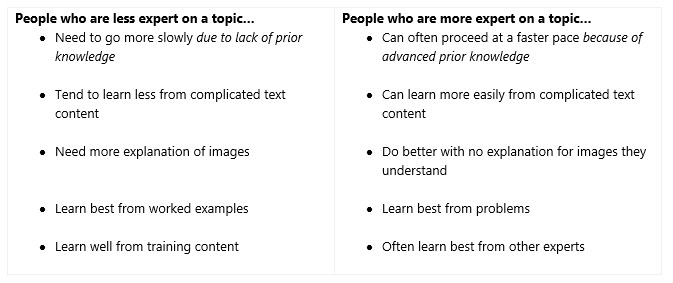
In this fascinating blog post from Patti Shank on the ATD site, she discusses the reasons we can't have a one-size-fits-all approach to training.
Aside from the typical learning styles excuse, Patti explores an interesting point related to neuroscience: knowledge and experience dictates the way we can present the content and further impacts the way the learner is able to work with it.
The crux of the difference is working memory vs. long term memory. When newbies are learning a topic, everything they "know" is in working memory - and they are paddling madly to keep processing and applying that information to the learning process. But when a more knowledgeable or more experienced employee has long-term memory associated with a topic, we can work with that topic in deeper and more meaningful ways for the learner.
This chart is an excellent comparison of working memory approaches to training vs. long term memory approaches. This chart may cause you to rethink your training designs altogether.
How will YOU reinforce the learning, once the training is over?

Exit
The Training Doctor was once shown the door at a client site when our response to the question: How are you going to reinforce this learning once the training is over? was... "That's not our job, that's your manager's jobs."
It was an eye-opening experience to realize that a company requesting training didn't feel responsible for ensuring the training would work or benefit the organization.So before you design or develop any training program, be sure to ask your potential client (external or internal): How will this new knowledge or skill be reinforced on-the-job once the training is over?I
t is important for a business / business unit to take responsibility for the training's success. There is only so much an external consultant or even an internal trainer can do to ensure that people are allowed to practice and master their new skills on-the-job once they leave the training.An extra service you might provide to your client is to create a list of options / ideas to reinforce the training. For instance:
They might schedule a weekly brown bag lunch check-in at which the newly trained employees could bring up new questions or share tips and tricks that they had learned since the end of the training and the practical application began. As trainers we know that it is not possible to teach everything in a training class and often the learners will discover short-cuts or other methods of working as they've had time to implement their new skills on-the-job; it would be helpful for everyone to know about the short-cuts rather than requiring each individual to figure it out on their own.
The training department might send out a series of emails which would reinforce some of the key points of the training. For instance, following a coaching class, a series of weekly emails might reinforce each step in the coaching process, such as Week 1: Remember to ask the employee how things are going from their perspective; Week 2: Probe and ask additional questions based on the answer(s) you got to the How is it going query. Week 3: Praise the things the employee has been doing right since your last coaching conversation, etc.
Suggest a follow-up check-in two to three weeks after the training (allowing time to practice on-the-job). At this follow up meeting the trainer would be available to answer questions or provide reinforcement of the key concepts.
Many times managers do not realize that their employees do not come back "fixed" after the initial training, and don't realize that they have to allow for time for practice on-the-job, so a simple suggested schedule for managers which identifies the time needed to practice (such as week 1 allow one hour of practice, week two allow 30 minutes of practice, etc. ) might be all that is needed to see success soar. This approach not only reinforces what was learned but gives employees permission to practice on the job, knowing that it is supported by management.
Whether or not you provide the suggested reinforcement techniques, the responsibility for reinforcing the new knowledge and skills lies with the managers. Trainees must be given time and permission to practice their new knowledge and skills until they are more competent than they could have been by simply "being trained."