
Want to test your cognitive abilities?

TestMyBrain is a not-for-profit initiative dedicated to collaborating with citizen scientists throughout the world by providing measurement tools that allow people to engage in science and learn about themselves. Currently the organization has tested over 1.5 million individuals in over 240 countries / territories.
Recent findings have identified that our cognitive abilities change as we age - and can tell you when you'll be the smartest.
If you'd like to participate, you'll not only be advancing research but you'll receive personalized feedback too (you'll see how you compare to the "average" person) !Tests change frequently, depending on the research being conducted and, sometimes, as the tests are being refined, the test itself may change from one day to the next.
Currently the website has tests for facial recognition, the ability to concentrate for periods of time and multiple memory types, among others. Begin testing YOUR brain today at: www.TestMyBrain.org
Note: this research was started by Harvard University but is now supported and managed by the nonprofit Many Brains Project, the Laboratory for Brain and Cognitive Health Technology at McLean Hospital & Harvard Medical School, and the Human Variation Lab at Wellesley College.
Teaching Thinking Through Synthesis

Synthesis
According to Bloom's Taxonomy Synthesis refers to the ability to put parts together to form a new whole. This may involve the production of a unique communication (theme or speech), a plan of operations (research proposal), or a set of abstract relations (scheme for classifying information). Learning outcomes in this area stress creative behaviors, with major emphasis on the formulation of new patterns and structures. According to the Merriam Webster dictionary, one definition of synthesis can be:
a combination of thesis and antithesis into a higher stage of truth
What do these definitions mean for us in the training department? How can we teach thinking through synthesis? Here are a few ideas:
In relation to Bloom's definition - ask your learners to read a case study, whitepaper or even an article on a topic and then distill it down to (options:) the most important idea, the most critical sentence, a sentence of their own making, three key words. If you are working with a group of trainees, give each of these assignments to different individuals or small-groups and then compare and contrast their responses. This process requires people to truly think about the content and how to express that content in a way that is easy to remember and agreed upon by all.
In relation to Merriam Webster's definition - have learners read two opposing articles, whitepapers, etc. and then come up with a new, balanced viewpoint or stance. Rarely are ideas completely opposed, so working with the ideas to identify their common ground is very useful in having a well-rounded understanding of a topic.
Interview with Karl Kapp re: Gamification

hardbackcoverlaying

kapp_book_image
What inspired you to write this book? T
wo things compelled me to write the book. The first is that I had been working on the concept of "gamification" before I even knew the word. I was/am a big video game fan and wanted to try to bring game concepts into the learning I was designing. I had started to do that but never had a word for it. Then, one day, I saw the word gamification and I said "that's it, that's what I've been trying to do." So I started researching the concept and learning more and more about it.
However, so many people, in my opinion, were getting gamification wrong. People were focused on the least exciting elements of games (points, badges and leaderboards) and they were focused only on making learning fun.
So the second reason I wrote the book was to try to provide research-based explanations and techniques of why gamification should be about engagement and not about "fun." I always say, "if you want someone to have fun...give them the day off." If you want them to learn, create engaging instruction.
If you could distill your message down to just one - what would it be?
Gamification is about engagement. The elements from games that make them engaging and interesting are the elements we should use in gamification of learning and instruction. We should not take a superficial dive into gamification, we need to really explore the elements of games that lead to engagement and learning. And, if I could sneak one more message in here it would be that gamification is based on research-backed principles. The ideas of learner motivation, spaced practice and spaced retrieval used in gamification have been shown to lead to positive learning outcomes. It's not bells and whistles, it's based on sound scientific methodology.
How would a learning professional best use your book?
I've written two books about gamification. One has a white cover (Gamification of Learning and Instruction: Game-based Methods and Strategies for Training and Education) and one has a black cover (Gamification of Learning and Instruction Fieldbook: Ideas into Practice).
The book with the white cover is designed to describe why gamification is effective, to highlight the research behind gamification and to explain how to match instructional content to certain types of games. It is more on the theory and justification of gamification.
The book with the black cover, the field book, is more about the implementation, it explains how to design interactive learning with gamification, games and simulations. It's the "how to book."
Do you have a personal motto related to the book?
My motto is to help people understand the convergence of learning, technology, games and gamification through engagement, fun, laughter and insight.
Bio
Karl M. Kapp, Professor of Instructional Technology, Bloomsburg University, Lynda.com author and author of six books including the Gamification of Learning series.
Writing Learning Objectives
Here is a useful article on Learning Objectives. It will help those who have to write them as well as those who wonder why training takes so long to develop.
The authors use a 5 concentric-circles view with the outer ring being the organizational objectives, and then subsequent circles being roles needed to fulfill the organizational objective, competencies and skills, and knowledge needed by those roles, and finally the learning objective itself.
VERY helpful in understanding how everything is intertwined.
The Limits of Working Memory and Training Effectiveness
learning
In this fascinating blog post from Patti Shank on the ATD site, she discusses the reasons we can't have a one-size-fits-all approach to training.
Aside from the typical learning styles excuse, Patti explores an interesting point related to neuroscience: knowledge and experience dictates the way we can present the content and further impacts the way the learner is able to work with it.
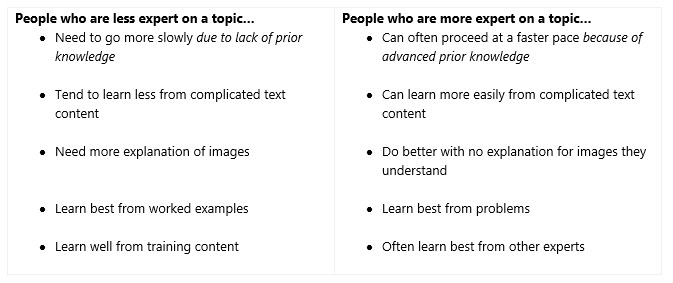
The crux of the difference is working memory vs. long term memory. When newbies are learning a topic, everything they "know" is in working memory - and they are paddling madly to keep processing and applying that information to the learning process. But when a more knowledgeable or more experienced employee has long-term memory associated with a topic, we can work with that topic in deeper and more meaningful ways for the learner.
This chart is an excellent comparison of working memory approaches to training vs. long term memory approaches. This chart may cause you to rethink your training designs altogether.
How will YOU reinforce the learning, once the training is over?

Exit
The Training Doctor was once shown the door at a client site when our response to the question: How are you going to reinforce this learning once the training is over? was... "That's not our job, that's your manager's jobs."
It was an eye-opening experience to realize that a company requesting training didn't feel responsible for ensuring the training would work or benefit the organization.So before you design or develop any training program, be sure to ask your potential client (external or internal): How will this new knowledge or skill be reinforced on-the-job once the training is over?I
t is important for a business / business unit to take responsibility for the training's success. There is only so much an external consultant or even an internal trainer can do to ensure that people are allowed to practice and master their new skills on-the-job once they leave the training.An extra service you might provide to your client is to create a list of options / ideas to reinforce the training. For instance:
They might schedule a weekly brown bag lunch check-in at which the newly trained employees could bring up new questions or share tips and tricks that they had learned since the end of the training and the practical application began. As trainers we know that it is not possible to teach everything in a training class and often the learners will discover short-cuts or other methods of working as they've had time to implement their new skills on-the-job; it would be helpful for everyone to know about the short-cuts rather than requiring each individual to figure it out on their own.
The training department might send out a series of emails which would reinforce some of the key points of the training. For instance, following a coaching class, a series of weekly emails might reinforce each step in the coaching process, such as Week 1: Remember to ask the employee how things are going from their perspective; Week 2: Probe and ask additional questions based on the answer(s) you got to the How is it going query. Week 3: Praise the things the employee has been doing right since your last coaching conversation, etc.
Suggest a follow-up check-in two to three weeks after the training (allowing time to practice on-the-job). At this follow up meeting the trainer would be available to answer questions or provide reinforcement of the key concepts.
Many times managers do not realize that their employees do not come back "fixed" after the initial training, and don't realize that they have to allow for time for practice on-the-job, so a simple suggested schedule for managers which identifies the time needed to practice (such as week 1 allow one hour of practice, week two allow 30 minutes of practice, etc. ) might be all that is needed to see success soar. This approach not only reinforces what was learned but gives employees permission to practice on the job, knowing that it is supported by management.
Whether or not you provide the suggested reinforcement techniques, the responsibility for reinforcing the new knowledge and skills lies with the managers. Trainees must be given time and permission to practice their new knowledge and skills until they are more competent than they could have been by simply "being trained."
Interview with Darlene Christopher, author

the-successful-virtual-classroom-book-cover
The Successful Virtual Classroom by Darlene Christopher
What motivated you to write this book?
I think that delivering training via virtual classrooms offers so much potential to organizations in terms of the ability to scale the delivery of training to dispersed audiences. The books I found on virtual classroom training focused on the "what" of virtual classroom training but I felt there was more to be explored in terms of the "how" so I decided to write about it.
I also included a chapter focused on delivering virtual training to global audiences since globalization is a growing trend affecting many organizations, yet little has been written about it.
If you could distill your message down to just one - what would it be?
Delivering training programs in a virtual classroom requires adjustments in two key areas in order to engage a live online audience: content and facilitation. Adjusting your content and facilitation techniques takes some time, but in return it saves travel time and cost for both the enterprise and learner.
How can trainers use this book to assist them in the work that they do?
The goal of this book is to provide facilitators and other training professionals with the tools and techniques to confidently design and facilitate engaging virtual programs. A supporting framework - the PREP model (plan, rehearse, execute, and post-session review) - is covered in detail.
The book is also filled with tools, checklists, and worksheets-as well as case studies from Oracle, UPS, and more. I aimed to make the book as practical as possible and I hope that training professionals will find the tips, sample exercises and icebreakers and real-world examples directly applicable to their work. 4
Darlene Christopher, Senior Knowledge & Learning Officer. World Bank
Entry Level Employment Skills - What Do Employers Want?
Last month SHRM and the consulting firm Mercer issued a joint report titled EntryLevel Job Applicant Skills.
They assessed 15 skills and attributes employers commonly look for including dependability, communication, creativity, and integrity, to name a few. The top "vote getters" (skills or attributes deemed most important) were:
Dependability and Reliability
Integrity
Respect
Teamwork
Interestingly, these are all soft-skills and attributes rather than the hard-skills (communication, problem solving) that many employers are saying candidates are missing at the entry-level. Less than a quarter of the survey respondents said mathematics was a critical entry-level skill.
The #1 tactic suggested for securing entry-level positions was career-related internships. Internships are able to help a potential employer assess the skills bulleted above. Panel interviews are the most widely used interview technique for assessing the desired attributes.
This study / survey has interesting implications for training...
If candidates lack these attributes... can we train for them?
Are these attributes prerequisites to skills training or entirely different from them?
Is it a Knowledge Check or a Quiz?

a-plus
In the midst of designing a facilitator-led curriculum for a client, we were met with a conundrum: according to our SME(s), one particular class just had to have a quiz at the end.
There were many problems with this idea, including the fact that none of the other 6 courses in the curriculum ended with a quiz and that the audience was new-hires - so how intimidating would a quiz be?
We finally compromised on a Knowledge Check - that way our SME felt fulfilled (and we fulfilled compliance requirements) but the learners wouldn't be too intimidated (we hoped).
What's the difference?
A quiz is used to check for comprehension. Did your attendees learn what you taught? A quiz can come in many forms - you might ask your learners to recognize an answer, as in the case of a multiple choice text. You might ask them to recall an answer, as in the case of fill-in-the-blank. Or you may ask them to think of the answer by giving a "case" and asking: What should you do next? In all cases the results of the test matter. There is a score (perhaps numeric, perhaps pass/fail). There is a record of that score. And often the scores are compared to one another - resulting in a ranking of some sort.
Alternatively, a knowledge check is more of a review. It's used to determine if the learners can find the answer. They are often allowed to use their learning materials (handouts, workbooks, etc.) and potentially to work together. A knowledge check might be in the form of a game (such as jeopardy) or it might be a solitary activity. Knowledge checks are often used to help solidify the learning, allow learners to review the content one more time, and enable them to leave the training more confident in what they learned.
A knowledge check is appropriate in all situations; a quiz is only appropriate if you have to ensure people know the answers before they leave training. There is some consequence to not knowing the answers (such as performing the job incorrectly), and you need to prove the "results" of the training.
Who Will Give Their Sign-Off on the final design of the training?

frustrated-with-computer
Who will give their sign-off on the final design of training seems like such an obvious answer that it does not need to be asked, right?
Wrong.
Not asking this question could result in a lot of wasted time and effort. Just like a needs-analysis, to determine exactly what type of training would meet the audience's needs, asking Who will be the final sign-off on the design is a way to ensure that the training you design meets the needs of the organization.
The Training Doctor was once involved in a project for a retail organization: working with the corporate Director of Operations to design training for the stores. The entire training had been designed and developed in close-association with the Director of Operations, who gave her approval. The program was then presented to the vice-president-of-something, who said within the first 5 minutes of seeing the final product: No, No, NO - this is not what I wanted at all!
In order to save yourself and your organization unnecessary frustration as well as lost time and money - whether you work internally or externally - be sure to always ask, Who will have the final sign-off on the training and, ideally, have a conversation with that person at the start of the project in order to understand what the expectations are. Who would have thought that the Director of Operations could have gotten it so wrong?
Teaching Thinking Through Comparison

fruit
One of the best ways to understand or learn something is to relate the new information to something you already know. Most people don't do this naturally, however. They often struggle with understanding new information and resort to memorization rather than working with the material to really understand it and internalize it.
Since most people don't take the time to do this on their own (or don't know how to), you can assist their learning by designing activities which cause them to focus on this comparison.
One way is to ask them to create an analogy. For instance, How is continuous improvement like a game of golf? Like building a house? Like shopping for a car? Like a basket of fruit?
Another option is to create a story. Assume your learner must learn the inventory layout in a cooking store. Their story might be about a customer who is throwing an important dinner party for their boss. What will they need to make it successful? What would you suggest they buy? Where are those things located in the store?
If you have an on-going curriculum, asking your learners to relate a new topic to the topics they've already learned is a helpful technique. This type of activity not only causes them to have to really understand the new material, but to understand it in a bigger context.
Try any one of these activities in your next training course and see if your learners don't say, "Oh, now I get it!"
Stop Teaching So Much! Learn to Chunk.
frustrated-with-computer
We recently reviewed a day-long course on coaching which was actually an excellent class, the only thing it suffered from was the typical: Too much content!
The course taught 4 different coaching techniques and their best-use given a particular type of workplace situation or a particular type of worker, and then participants were given some time to choose one of their own workers with whom they thought the technique might work. Finally, they were divided in to trios to practice the technique.
This learn-and-practice process was repeated four times for each of the four techniques. The problem with this course was that the learning outcomes were just not going to be that great. It is impossible to learn four different techniques, and remember when they apply, and the nuances of usage, when you get back on the job when you've been taught them all in one-fell-swoop.The expected learning outcomes for this class just weren't being achieved, despite excellent content and a "reasonable enough" teaching strategy.
While it certainly takes longer to teach in chunks, and allow participants real-world practice and application, it does lead to better learning outcomes.The next time you are designing a course - especially one that requires practice in order to master - ask yourself: Will people really be able to do Skill #1 when they are back on the job if that information and technique has been "over written" by additional knowledge and skills by the end of the day?
Chances are, you can achieve much better learning outcomes by chunking the content and the periods of teaching, and allowing your participants to have time to not only reflect on what they learned, but also put it in to practice, and then reflecting on how effective that practice and its outcomes really were.
What is most important in solving this problem - Quality, Speed or Cost?
Most of us know the 3-points of any project: quality, speed, and cost, and the fact that it is impossible to have all three.
Given the reality of today's training environment in which budgets are slashed and time allowed for training has been reduced, the question: What is most important in solving this problem, quality speed or cost, is critical to ensure success with any training endeavor.
If quality is most important, then your project will take time and undoubtedly will cost "more" money than a project that doesn't have quality as its most important factor.
If time (project due by the end of this month) is the most important factor, then quality will take a back seat and higher costs will probably prevail in order to get more people or services involved in the creation of the training.
When designing and developing new training for your orginization, this is a very useful question to ask because it helps you to know where to assign your resources and/or it helps you to know what resources to ask for.
So, if time is the most important factor, you may want to request an extra pair of hands such as a consultant or a temporary service. If quality is the most important factor, you may want to price the project and then request an extra 25% in funding.
What is most important to solving this problem: quality, speed or cost is a critical business question which will help you to create a better training product and outcome.
Teaching Thinking through Changing Perspective

etsy-diy-kaleidoscope-how-tuesday-clare-mcgibbon-final
One of the ways you can help people to improve their thinking skills is to ask them to change their perspective on a topic. To think about it from another point of view. This is very easy to do in a training situation - since we have folks captive and can ask them to try an activity in a way they are not naturally inclined to.
Unfortunately, we often miss this opportunity in training and instead ask our participants to answer a question based on their own perspective or opinion. For example, how often does your training program ask something along the lines of: Now that you have read the case study, what are the three main factors affecting the situation? Since people respond with their own opinion, we never tell them that they are wrong, of course (nor are they wrong), but do we ever conduct "round 2" of the questioning / debrief and ask the learners, What if you were the banker, contractor, pilot in the situation? THEN what would you say are the three most important factors?
Here are two techniques for getting people to change their perspective on a topic:
1. Collaboration - Having learners work in groups is an easy and natural way to hear more than one perspective. Some care needs to be given to structuring the collaborative activity so that "minority viewpoints" aren't ignored. Perhaps rewarding the group with the most perspectives? Or the most unique perspective?
2. Suggest the other viewpoint - Credit here goes to MindGym and Sebastian Bailey for this simple exercise presented at a conference in 2015. In this type of activity you'll tell the learner exactly the perspective you want them to take. Bailey's exercise went like this: Close your eyes and picture your living room for 30 seconds. Now, picture it again, from the perspective of an interior designer. Again, think of your living room, from this perspective, for 30 seconds. Once more, think of your living room, and this time from the perspective of a robber. What are your insights? What do you see differently? What “Ah-ha” moments have you had? What did you "see" as the interior decorator that you didn't see before? What about from the perspective of the robber?
Interestingly, asking people to change the way they view a situation is something that develops with maturity. It is almost impossible to ask anyone under the age of 18 to change their perspective on a situation. Once someone IS able to look at things from various points of view however, it is wise to continually build that muscle and it will expand their thinking abilities in all areas of their life.
Where were you in 1991?
Twenty-five years ago The Training Doctor was born!
Here's a look back at what else was going on at that time. Where were you?
The Persian Gulf war ended with a cease fire
Boris Yeltsin was the first elected president of Russia
George Bush (#1) was president of the United States
The median US household income was $30,000
Unemployment was approximately 7%
A first-class stamp cost 25 cents
The NY Giants won the Super Bowl by one point (the cost of an ad was $800,000 compared to $5 million+ today)
Nirvana (the band) becomes an American icon
Dances with Wolves won an Oscar for best picture
Tim Berners-Lee created the internet! (thank you, thank you)
Richard Branson completed the first transatlantic hot air balloon flight
Dr. Seuss died