
Why do so Many Companies Get Training Wrong?

Earlier in 2017 I was interviewed by the BBC for an article on workplace training and specifically, why companies get it wrong so often. As one of a few expert sources for the article, my entire response was not included, but I wanted to share it with you here.
WRONG: Cram all the learning in to the shortest amount of time possible
Solution: Mete it Out Over Time
One of the biggest contributors to the lack of training effectiveness is that we simply don’t allow enough time for training. First, companies have cut what used to be an 8-hour training day back to 4 hours, or two hours, in many cases. Sometimes it’s even been turned into a boring PowerPoint self-study (this violates a lot of adult learning principles, but we won’t go there today).
Secondly, in combination with the shorter time allotted for training, we deliver all the content in one “sitting.” While this is a great approach for an overview or introduction to a topic, it never develops into learning and skill. So the first thing we must do to make workplace training better is to mete the content out, over time. Learners need an introductory period, a practice period, a period for reflection and a period for perfection. This process cannot be compressed into 4 hours. The brain doesn’t process new information that way and the body doesn’t develop the muscle memory or finesse it needs to perform a skill this way either. (Here is an interesting article on the benefits of spaced learning in training medical professionals.)
WRONG: Teaching things in "theory"
Solution: Real World Application
This best practice has two angles. The first goes hand-in-hand with the meted content suggested above. If you are going to space the learning out over a period of time, you have the ability to assign real-world activities to the learners. This allows them to put what they’ve learned into practice and develop a better understanding of the concept as well as the muscle memory required to perform it. For example, in a sales training course, if step one is to identify prospects – the assignment should be to return to the next lesson having identified and vetted at least three prospects using the skills taught in lesson one. The assignment after lesson two should be to again start at prospecting and then add step two. This allows the leaners to learn-do-reflect-perfect.
The other angle is to have learners work with real-world concepts during the learning time itself. You could have a training class that teaches learners to read financial statements such as profit and loss, cash flow, etc. in a “vacuum,” or you could have them learn to read these same reports while looking at the annual report for their own company, or their competitor. Rather than learning things in “theory,” have your workers learn the same concepts with real-world benefits.
WRONG: Not including management in the training process
Solution: Management Involvement
Management involvement is crucial for real learning in so many ways. First, it is important that managers understand what their workers are learning so that they can reinforce it (how many of us conduct a manager’s overview or ask for their participation before their workers come to us?). Second managers can assist in the practice/perfection phase of training by allowing their workers extra time to complete their newly learned processes (in other words suspending metrics during the practice phase) and by answering questions or providing coaching. Finally, managers are the best choice for evaluating the true outcomes of training. They are the ones who see if the workers are able to truly implement what they learned on-the-job.
WRONG: Having no real plan for training: who gets trained, in what, and why?
Solution: Make it a Strategy
I can’t decide if this failure is the most damning, or if the way we slice and dice content to cut it back to the most minimal amount of time it will take to transmit it is; so this is either #1 or #2 in terms of what companies do wrong when training their workers. For years now – decades- we have trained people in silos (if you are a salesperson all of your learning will be related to sales, somehow) and we administer training on an as-needed basis. If you are good at what you do, are performing well and aren’t in-line for a promotion – you could go years with no training at all. But in order to develop our workers, and our organizations, training needs to be a strategy. What could we teach someone that would make them that much better of a performer? Some “generic” topics that come to mind are finance, continuous improvement, and project management. There is no person in the workplace that couldn’t benefit from having these three skills; yet, if you aren’t a project manager, you’ll probably never get project management training. Companies are short sighted and tend to compartmentalize training as a “department” rather than utilizing training as a strategy that can make their organization better. If companies developed a strategic plan for employee development – like they do for company initiatives such as product launches or facilities expansion – in no time at all they would reap the rewards of a more capable, productive workforce. What are your thoughts? Why do so many companies get training wrong? You can see the original BBC article here.
Developing Well Rounded Leaders - Future-Proofing Your Organization

A recent MBA World blog posting by Juliette Alban-Metcalfe makes a strong point about developing a learning culture in organizations, “We can’t afford to maintain the silos we’ve built up and ignored for years.” In this simple statement, she challenges us as L+D professionals to address a very important issue – Developing Well-Rounded Leaders. Specifically, let’s look at mid-career professionals.
For years, possibly decades, we have helped people develop expertise around specific jobs, or how to do their current job better. What was often neglected was the need to expand the knowledge, skills, and abilities of our future leaders and executives. What we’ve created is a talent base that is very skilled in a narrow area of expertise, but not well prepared for upper management or executive positions. For example, if you started in accounting you might end up as a director or VP of finance, but would you know anything about operations or marketing? If you started as an HR generalist you might end up as a benefits specialist or HR manager, but would you know the sales cycle of your organization or how your company really makes money?
Estimates are that by 2030, Baby Boomers will be completely out of the workforce. This presents a call to action and an opportunity, because the generation with the most breadth and depth of work experience will be leaving the workforce. We – as L+D departments and professionals – need to quickly rectify the silos of specialists we’ve created by broadening the role-specific training of the past in order to address the workforce needs of the future. Our challenge is to develop a new generation of company leaders capable of making well-rounded and well-informed decisions based on their experiences in a multitude of business areas.
So what types of things should we be helping employees to learn - and how? Some of the “basic” and important leadership skills include:
Strategy
Many employees don’t know the strategy and the vision of their organization. They are so focused on their individual job, or perhaps their business unit goals, they miss the big-picture future of the organization and the plan for getting there. The 2016 Wells Fargo scandal is a perfect example of mid-level leadership focusing on business unit goals (sales) and not the overall success of the business.
Competitor Knowledge
This is something we’ve seen particularly lacking in sales professionals. They know how to sell their own products or services, but get caught short in being able to “sell” them as the best choice in comparison to their competitors. For example, What is the difference between Uber and Lyft? Why would you choose Dropbox over Box? This is not to pick on sales professionals; in an ideal world ALL employees would understand their company mission, vision, strategy (see above) and competitive advantage. What makes your company unique and ultimately the better choice?
How the Company Makes Money
Surprisingly few individuals understand their company’s business model or how it makes (or spends) money. For example, a retail organization typically only nets 2 cents on every revenue dollar. Selling copiers or printers is really a loss leader, while the company makes their money on toner and ink. Understanding how the company makes money helps individuals make better decisions regarding expenditures, negotiations, investments and more.
Continuous Improvement
Continuous improvement is a concept that every individual, at every level of an organization, should not only understand, but embrace. There is always a better way to do something and each individual should be responsible for ensuring that their job is done in the most logical, efficient, ethical manner. Continuous improvement is a structured process that helps a company make incremental improvements over time or achieve “breakthrough” improvements quickly.
Stakeholder Management
A stakeholder is someone with an interest or position on a topic. Everyone and every project has one or more stakeholders. Sometimes the stakeholders are the company’s customers or shareholders, sometimes they are the boss, and sometimes they can be the peer sitting in the next cubicle. Knowing who the stakeholders are (at the company level as well as the individual worker level) helps employees to “see the big picture” and make better decisions as a result.
These are just a few of the top skills needed in today’s fast-paced workplace. The next question is – how do we help employees acquire this kind of knowledge and skill? As most people are aware – knowing about something and being able to do something are two ends of a spectrum. It’s not enough to know your company’s competitive advantage or what continuous improvement is all about. Learning opportunities need to be structured to ensure real-world, on the job experiences.
One idea, which has been around for many decades, but which is rarely used, is job rotation. Anyone who aspires to leadership in an organization should work in at least three different areas of the business. Most importantly, they should work in an area related to the customer. This might be operations, shipping, sales, etc. Unfortunately, most companies reserve their rotational programs for people who are already identified as “high potential.” A better approach would be to create an immersion program for all employees, so that everyone has a more well-rounded view of the organization.
This not only will help in making employees more educated about the business and their role in it, but it also helps tremendously with retention. Most people who leave an organization do so because they feel there is no growth or advancement for them in their current role. But what if they were able to identify their own future role? Participating in a rotational program gives employees exposure to areas of the business they might never be a part of and could inspire them to contribute to the organization in many ways.
The focus on job-specific training is a thing of the past. Organizations must focus on developing well-rounded individuals who can take the organization into the future. The future success of our companies depends on the actions we take today to develop our future workforce.
Note: This article was originally written for, and published by, MBA World, and co-authored with Keith Plemmons.
Teaching Thinking through Adapted Appreciative Inquiry

If you've been a reader of this blog for any period of time, you know that using questions is something we regularly advocate for in order to change people's thinking and thereby change their behavior on the job.
But what if your learners have no preconceived notions on a topic to begin with? What if we don't want to change their thinking, we simply want to e x p a n d their thinking? That's when Appreciative Inquiry can be an excellent tool for teaching thinking skills.
Appreciative Inquiry, in its purest sense, is used as a change management /problem solving tool. Rather than gathering people (managers, workers, etc.) together and asking "What's going wrong, and how do we fix it?" Appreciative Inquiry instead asks, "What are our strengths? What are we great at? How can we maximize that and build on it to achieve excellence?"
Appreciative inquiry has been around since the late 1980's but hasn't been "in the news" much in the last decade or so. Perhaps it's time to revitalize the approach, with a different spin - let's use it to teach thinking. The way we envision using the technique is through possibility summits which help newer or younger associates within a company to help set the course for the future. Too often, when individuals have been with a company 20, 30 or 40 years, they are set in their ways. Why change? Things are working great.
But organizations that rest on their laurels are organizations that will ultimately fail. Younger associates may have great ideas but no knowledge of how to advocate for them or execute them. Appreciative Inquiry can help individuals and organizations to thrive. Here's how....
Adapted Appreciative Inquiry Process
Allow the "younger generation," if you will, to help envision the future and empower them to create it by utilizing an adapted Appreciative Inquiry Process:
First, craft questions that help to open up future lines of inquiry, such as "What is your vision (not expectation) for our company in five years?" "What do customers love about us?" "What are our strengths in __________ area or department?" Questions should be crafted to get at opportunities, competencies, and business ecosystems (such as working in conjunction with suppliers, competitors or customers). A more inspirational or free-flowing question might be: "It's 2025 and Fortune Magazine has just named us the most _______ company in America. How did we get there?"
Next, assign people who are newer in the organization to interview those with more tenure - using the questions created in the first step. This accomplishes two things: It devoids the idea that those at the top of the organization know best and opens up channels of conversation - It helps to develop relationships between people who might not normally interact in their day-to-day roles (for example, the CEO of the company being interviewed by someone in the shipping department), and the results of that can be amazing, not only for inspiration but for goodwill and long-term relationships.
Third, those who have conducted the interviews report back on what they've learned, and themes (strengths) and actions items are culled from the results.
Finally, the action items are prioritized (what can be done most quickly, what can be done most affordably, what will get us to our ultimate vision for the future, etc.) and assigned. Ideally, multi-tenure teams will be assigned to work on the action items, which helps to establish mentorship even if the company doesn't have a formal mentoring program.
Note: You may choose to focus these steps on a theme in order to keep the process more manageable. The theme might be #1 in Customer Satisfaction and the steps would then focus on that vision for the future. For instance: What is possible, in our billing department, to ensure we are #1 in Customer Satisfaction?
Benefits of Appreciative Inquiry Integrated with a Curriculum
When this type of activity is integrated with a Teaching Thinking curriculum, it exposes those enrolled in the curriculum to new ways of thinking that they simply would not come up with on their own. It also exposes them to real-world experience and capabilities, rather than contrived activities with expected outcomes. Finally, it unites the organization because everyone has a hand in the creation of the future (there are elements of social constructionism in this type of learning activity).Combining vision and experience enables an organization to reach new heights.
Giving Your Product Away - Bombas Case Study

Periodically, The Training Doctor releases case studies used in our Teaching Thinking Curriculum. Since we want everyone to improve their thinking skills - not just those who are enabled to do so through their employer-sponsored training - we offer these case studies for use in your personal development, corporate or higher-ed classrooms. In the Bombas case study you'll be able to discuss and dissect concepts around:
Ethics
Product development
Corporate/Social impact
Super-niche Bombas makes one product and one product only - socks. And half the products they make they give away through partnerships with 600 organizations in all 50 US states. How do they stay in business? How is it sustainable? What is the company's real mission?
Learn more here and develop your thinking skills by using the discussion questions posed at the end of the case study.
Why Knowledge Management is NOT the Answer
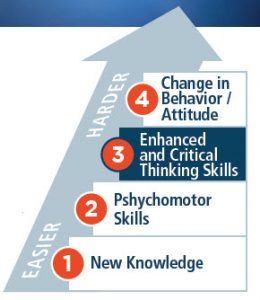
4 Levels of Learning Outcomes
According to Wikipedia, Knowledge Management (KM) is the process of creating, sharing, using and managing the knowledge and information of an organization.
At first-read this sounds like a great idea, and many organizations have spent many millions of dollars in the last 20 years to collect and catalog the knowledge their employees possess, in order to "preserve" it and share it.
There is one glaring problem with this approach - knowing what you know and knowing how you arrived at the answer are worlds apart. As the illustration shows us, knowledge is at the lowest level of learning. Indeed it is the foundation upon which all learning, skill and ability is built, but having knowledge alone is not enough.
For individuals and organizations to have success, there needs to be a transfer of thinking skills- not just information. For example, in one organization we've worked with, the transfer of thinking skills started with asking senior associates to write a short synopsis of the six "defining moments" of their career - when did they have an “ah-ha” moment and how did it change how they worked? These were then categorized in to themes such as loss, growth, conflict, strategy, competitive advantage, etc.
The same senior associates were then interviewed to get more detail about their "stories" - what they had learned and how. Questions such as, "Was there a single factor that influenced your _____," or "If you had the opportunity to give advice to your younger self, what would you advise?"
Finally, the "best" stories in each category (loss, growth, etc.) were chosen and those same senior associates were interviewed, on camera, a'la 60 Minutes, to tell their story in five minutes or less. The previous steps of writing the story out and thinking aloud through interviews helped the associates to succinctly transmit the situation, the outcome and the lessons learned.
In just under two months the organization captured the best thinking from the most experienced people in the organization. The videos were used as "teasers" to get learners interested in the topic (theme) and the other stories were made available in a case study format for learner's reference.
The collection of thinking is available to be disseminated via multiple modalities - on the company's intranet, via a monthly internal newsletter, on-demand from the learning portal, and in leadership training offerings.
An interesting outcome of the project is that other associates have come forward to voluntarily share their thinking as well. They want to share their career defining moments and learnings with the organization and other associates. The organization now has an archive of what, why, and how, rather than a collection of simply what.
Invest in Critical Thinking = HUGE ROI

Some organizations still believe training is a cost-center rather than a money maker.
But the right training, applied at the right time, can have exponential returns! According to this short report on Critical Thinking, published by Pearson in 2013, the return on investment for critical thinking tends to be extremely high. Research has shown that when training moves a $60,000 a year manager or professional from “average" to "superior," the ROI is $28,000 annually. (emphasis, ours) 4
How would your organization like to make $28,000 per year, on each of its managers? We can help. It's what we do.
Smart Pills - Is it Possible to Enhance Your Thinking?

are smart pills real?
Thinking - like any skill - requires practice to improve... right? What if there was a way to make yourself smarter with no effort? What if you could just pop a pill to increase cognition?
The smart pill idea was introduced to the mainstream by the movie Limitless in 2011 (and subsequently a TV show by the same name in 2015).In the movie the main character, Edward Morra, is able to become hyper-focused, productive and perceptive through the use of a nootropic drug called NZT-48. He is able to write a book in four days, make rationale and spot-on stock picks and more.
Believe it or not, there is some truth to this. Many ADD / ADHD medications are considered smart pills - not because they make people smart(er) but because they can help people to focus and concentrate - thereby being better able to take-in and process information. Just as a computer enhances efficiency by helping you to create and store information, a smart pill can increase mental efficiency and abilities.
The most commonly used smart pill in the US is Modafinil - which is used off-label for increased wakefulness and focus. The original purpose of the drug is to solve narcolepsy and certain types of sleep apnea. A 2008 article by TechCrunch founder Michael Arrington dubbed it an entrepreneur's "drug of choice" as opposed to illicit drugs which might cause addiction (Modafinil has no side effects and is not habit forming), although he does question the wisdom of staying up 20 hours straight.
It Works
In addition to anecdotal evidence that nootropics work, a meta-analysis of 24 studies was conducted jointly by researchers at Harvard Medical School and Oxford, which showed that Modafinil does indeed increase cognition. What's interesting is that the most benefits are derived in relation to complex tasks such as planning and decision making - as opposed to simpler tasks such as pressing the right button at the right time. Given today's business environment, which requires quick and complex thinking tasks - Modifinil might be the next required "tool" in a company's toolbox.
Increased Focus Isn't Always the Best Outcome
The Harvard / Oxford study also cautioned that focused thinking is not always the desired outcome. There is evidence that divergent thinking is inhibited by the drug, so jobs and tasks that demand creativity and innovation may suffer.
Do Smart Pills Create an Ethical Dilemma?
The use of smart pills poses some questions for the workplace, such as: should stimulant use be banned or approved? We do allow caffeine and nicotine which have similar effects. How do we differentiate or draw the line for a drug such as Modafinil?
The TechCrunch article joked that venture capitalists might require business owners to take the drug, to ensure their investment / company success. Some colleges are already banning the use of these drugs (Duke University has revised its policy on drug-use to include banning "unauthorized use of prescription medicine to enhance academic performance"); but other "smart drugs" include Ritalin (which increases memory and retention) and Adderall, so aren't schools then penalizing young people who need these medications? (Note: The percentage of young adults prescribed ADD / ADHD medication nearly doubled between 2008 and 2013.)
Research suggests that cognition-enhancing drugs offer the greatest performance boost among individuals with low-to-average intelligence (Scientific American March 1, 2016). So banning the drugs could harm both those who need it and those who could most benefit from it.
We ask these questions because this is where the discussion is happening right now, but give it a few years and we'll be having these same discussions in the workplace - either because everyone will be looking for an advantage in order to get ahead, or because the youth who have relied on these medications for success in childhood will graduate to working in business and may still be taking these cognitive enhancers.
Bottom Line
The bottom line is - smart pills don't increase the size of your brain or the number of neurotransmitters, or make you able to learn something you aren't inherently able to learn in the first place. They simply help you to focus for longer periods of time, thereby increasing your abilities related to complex cognitive tasks.
When it comes to learning, one millennial cautions: While smart drugs allow for instant improvement, they overlook what can be learned from the process of improving. Here here!
Would Your Employees Train on Their Own Time?
"The company has to look forward and transform. If it doesn’t, mark my words, in 3 years we'll be managing decline." [2016] Randall Stevenson, CEO of AT+T

AT+T has been swimming upstream for 20+ years now.
Long gone are the times of one landline in everyone's home. In order to survive, the company has adapted to, embraced, and conquered cellular networks, cable television, fiber optic networks, satellite networks and streaming networks - all on a national scale.
In order to keep up with the rapid changes in technology and infrastructure, their employees have had to constantly change, adapt and grow as well.
Is your company forward-thinking enough to do what AT+T has done?
Between 2013 and 2016 AT+T spent $250 million on employee education and professional development programs. According to Stevenson, the CEO, employees are expected to put in 5 - 10 hours a week in professional development - on their own time. The company pays for or supports their educational efforts but does not directly supply all the training that is needed.
Additionally, the company created their own masters program in conjunction with GA Tech; and then opened it up to the public via Udacity. There were two reasons for this . 1) they couldn't find enough people graduating with the skills that they needed to fill the positions they had open - so they had to create a bigger supply somehow, and 2) Any member of the "public" who enrolls is a potential (well educated) future employee - so they are building a pipeline of skilled employees.
Now THAT's a future-thinking organization.
Ethics, Leadership, Volkswagen - case study

Periodically, The Training Doctor releases case studies used in our Teaching Thinking Curriculum.Since we want everyone to improve their thinking skills - not just those who are enabled to do so through their employer-sponsored training - we offer these case studies for use in your personal development, corporate or higher ed classrooms.
In the Volkswagen case study, you'll be able to discuss and dissect concepts around:
Ethics
Leadership
Decision making
Stakeholders
In September of 2015, the United States Environmental Protection Agency (EPA) accused the automaker of installing engine control unit (ECU) software in its diesel cars (beginning in 2008). The software worked as a "defeat device," allowing VW models to avoid violating the Clean Air Act by sensing when the cars were being subject to emissions testing, enabling emissions controls, and thereby enabling VW brand cars to pass inspection.
However, during normal driving conditions, emission control software was shut off in order to attain greater fuel economy and additional power, resulting in as much as 40 times more pollution than allowed by law. Eventually, VW admitted that the sensing device was installed in approximately 11 million vehicles in both the US and Canada.
Learn more here and develop your thinking skills by using the discussion questions posed at the end of the case study.
Update: March 2019. VW has been charged by the Securities and Exchange Commission (SEC) with securities fraud to the tune of $13 billion.
How Apprenticeships and Teaching Thinking go Hand-in-Hand

If I were to ask you to picture a cell phone - would you picture a baseball sized item, battleship grey, with a silver antenna you had to pull out of the top? Of course not. That is a cell phone of yesteryear.
Yet, when we mention the word "apprenticeship" to organizations or individuals, the most frequent reaction is, "Oh, that's not for us/me; apprenticeships are for manufacturing, hands-on labor, blue-collar jobs."
Not so! Those are apprenticeships of yesteryear.
Welcome to the new era of apprenticeships - they just might save your organization.
On June 29th President Trump signed an Executive Order - Apprenticeship and Workforce of Tomorrow - to expand apprenticeships in the US. The goal is 5 million apprenticeships in the next 5 years (currently there are 450,000 registered apprenticeships in America).
It shall be the policy of the Federal Government to provide more affordable pathways to secure, high paying jobs by promoting apprenticeships and effective workforce development programs.
According to the Department of Labor, companies in all sectors of the American economy are facing complex workforce challenges and increasingly competitive domestic and global markets. Apprenticeships are one key to helping people who have been left behind by shifts in the economy and how work is done.
The Success of Apprenticeships
Apprenticeships are a standard route to a career in much of Europe. Germany, especially, is known for its exceptional apprenticeship model. In Germany, half of high school graduates choose a track that combines training on-the-job with further education at a vocational institution (as opposed to the US, in which less than 5% of young people participate in apprenticeship programs). The mainstream nature of apprenticeships in Germany contributes to the country having the lowest youth unemployment rate in Europe.
Apprenticeships are an acceptable and highly respected alternative to college. At the John Deere plant in Mannheim, over 3,000 young people a year vie for 60 apprentice spots; likewise, at Deutsche Bank in Frankfurt, over 22,000 applicants vie for just 425 places.
Another benefit that Germany reaps from its well-seasoned apprenticeship program is keeping manufacturing jobs in the country. However, apprenticeships are no longer focused solely on manufacturing or "trades." Apprenticeships are now common in IT, banking, hospitality, and healthcare.
In the future, there will be robots to turn the screws. We don't need workers for that. What we need are people who can solve problems - skilled, thoughtful, self-reliant employees who understand company goals and methods. (German educator)
Perhaps it won't work in America
There are a number of reasons why apprentice programs may not work in America, unfortunately. Naysayers cite costs, stigma, cooperation, changing belief systems, and turning a big ship around. In short, it's not going to be quick, and it's not going to be easy.
In the United States there is a tendency toward higher education as the path to career options, although a recent article in the Chronicle of Higher Education admits "something about the path from college to career is not working for many people. “In recent decades we've seen corporate America severely reduce the budgets of training departments and cut back the hours allotted for training, per individual. The cost of apprenticeship programs is largely borne by the employer (German companies say their costs range from $25,000 to $80,000 per apprentice) and take two to six years to complete.
One program, at a Siemens plant here in the US (Charlotte NC), reportedly spends $170,000 per apprentice. Cost should be seen as an investment, say German proponents. Rather than looking for immediate ROI, companies need to look to longer-term benefits such as a ready and able talent pool, long-term employees (studies have shown that apprentices stay with the company that trained them - a loyalty is established), and workers who understand their organization's culture and goals. Additionally, there is a social component - skilling individuals for blue-collar, white-collar, and jobs of-the-future is one of the best ways to cure income inequality.
Americans aren't simply going to jettison old attitudes and decide, for example, that long-term gains, however broad, should trump short-term ROI.
Unlike in Europe, where apprenticeships are integrated into the educational system (in Switzerland students are introduced to apprenticeships as early as fourth grade and Swiss high schoolers are ready to work upon graduation, having started their apprenticeships around age 15).
The minimal apprenticeship programs currently available in the US are "marginalized and have almost no connection, or very limited or tenuous connections, to either our secondary-education or our higher-education systems," says Mary Alice McCarthy, who directs the Center on Education and Skills at the think tank New America.
Despite these perceived drawbacks and challenges, the Department of Labor is ready to help those organizations that do want to begin apprenticeship programs.
The Benefits of Apprenticeship Programs
First, the benefits to individuals: The benefit most widely touted is "college without debt." Apprenticeships always include some form of higher education; sometimes the ratio is 1:1 (equal amounts of time in the classroom and on the job) and sometimes the proportion varies one way or the other. Many apprenticeships culminate in a two-year degree, but the length of time to achieve it may not be exactly two years. If one is enrolled in an apprenticeship, the employer pays for most, if not all, of the tuition with the associated college. Generally employers partner with local colleges (such as community or technical colleges).
Another individual benefit is "earn while you learn." All internships are paid positions. The apprentice does not make the same wages as a fully qualified individual in the role, but that is offset by the amount of tuition they are the beneficiary of. Also, once the apprenticeship is completed, the individual's compensation usually rises substantially.
Other advantages include having a "foot in the door," having re-marketable skills (although, as cited earlier, most apprentices stay with the employer that trained them), and a work-record that aligns with their degree (as opposed to most college graduates who have a degree but no real-world work experience).
Likewise, there are substantial benefits to the employer: One of the most attractive benefits of instituting an apprenticeship program is the ability to "grow your own." Even if companies can find qualified individuals in the general population, oftentimes they come with abilities that don't mesh with the new employer.
For example, the Dartmouth-Hitchcock health system in Lebanon NH runs a 15-month long apprenticeship program to train medical coders, pharmacy techs, and medical assistants. The program was instituted to fight the constant battle of trying to find appropriately skilled individuals in the local area, but the health system's director of workforce development also cited the challenge of hiring workers from other hospitals in the area who "often don't have the same level of competence."
An apprenticeship program also ensures a steady-stream of skilled individuals for the key roles an organization has identified. Rather than trying to beg, borrow or steal already trained employees from other organizations (which doesn't ensure the "ideal" candidate and can cost tens-of-thousands of dollars in recruiting, interviewing and onboarding costs) an employer knows the quality and capability of the apprentices in their pipeline. Apprentice programs quell the panic of "where will we find xxx?"
Apprentices have also been "schooled" in the company culture, work-ethic, values, processes, etc. Many employers cite these intangibles as "invaluable." For instance, at Bosch, a manufacturing organization with facilities in Germany, as well as South Carolina, US, a mistake on the factory floor can potentially cost a million dollars; the director of the apprenticeship program says that the company is confident in the skills as well as the level of responsibility their apprentices have when on the job. In many ways apprenticeships offer a substantial return on investment.
Apprenticeships are no longer limited to manufacturing or construction, as in the past. Today's apprenticeships prepare individuals for careers in healthcare, IT, financial services, insurance and more. In fact, instructional design would make an ideal apprenticeship topic because it is a nuanced skill with much theory to know and practice required to master.
Finally, the Department of Labor is ready with grants and support to help organizations begin apprenticeship programs. The DOL cites benefits such as attracting a new and more diverse talent pool, investing in talent that keeps pace with industry advances, and closing gaps in workers' skills and credentials which undermine productivity and profitability.
Apprenticeship Programs Align with Teaching Thinking Skills
Many of the approaches and benefits of apprenticeships are also built in to a teaching thinking curriculum.
The extended timeline for learning (years, not days or hours), the on-the-job experience and practicality, the incorporation of coaches or mentors, teaching soft-skills such as teamwork and self-management, the structured nature of the learning process which ensures that all participants are learning the same skills in the same order and on the same timetable, the focus on white-collar jobs, and more.
Soft skills are actually better taught in a business environment than they are in a classroom. In a classroom the consequences are very different.
How to Get Started
If your organization would like to explore the possibilities of an apprenticeship program, call us, or go to the Department of Labor web page for resources such as a Quick-Start Toolkit, a list of tax incentives and credits, and information on how to access federal funding to build your program and / or pay stipends to your learners.
Think About It... Your Customer Doesn't Need You Anymore

Think
Dean Foods Company's—suppliers of milk and other dairy products—biggest customer is WalMart.
Last year (2016) WalMart announced that they would build their own milk processing plan to supply their stores (less than 1/4 of stores), and Dean's stock took a significant hit. The plant is about to open (July 2017) and Dean's stock took a hit again.
Here are some questions to think about, at your next management meeting, in order to "future proof" your organization:-
What product or service does your company supply, that a customer could ultimately supply themselves, if they chose to?- What is the likelihood that a customer of yours would look to "build their own" as opposed to your losing their business to a competitor? - What is the advantage to WalMart? They are supplying approximately 600 stores, located closely together in the central US.
Where do Attorneys Come From?

If you work for a large enough organization, you undoubtedly have a law department.
Have you ever wondered where the attorneys come from? Not straight from law school, that's for sure. Your organization acquired them from somewhere else - usually from a law firm.
Law firms are in an unenviable situation. First, they must deploy employee training from day one - law school does not make one an attorney, it simply teaches one about the law. Second, the average tenure at a law firm is 5.4 years. And, most lawyers who leave their firms do not go to another firm - they usually go to corporate America.
So, you're welcome. Law firms are footing the bill for you to the tune of $200,000 per attorney according to our source.
What roles would you train for - from scratch - in your organization? What jobs does the organization prioritize? How does your company stay in business - who are you dependent on? How much is your company willing to invest to "grow" a stellar employee? See this related article for some ideas on how to training employees from the ground up.
Do YOU Have 30 Years to Wait to Develop Leaders at Your Company?
Organizational Development research tells us that it takes 30 years of on-the-job experience for someone to acquire enough well-rounded skills to be a successful leader. In addition to on-the-job experience, it is important to have experience in numerous areas of business. Hence time on-the-job + exposure to many areas of business = a C-level individual with the perspective needed to run an organization. But thirty years? Who has that kind of time?
Here are a few profiles of organizational leaders who have been on that 30 year journey:
Mary Barra, Chairman and CEO of General Motors
Prior to becoming the CEO, Barra worked in product development, purchasing and supply chain, human resources, global manufacturing engineering, as a plant manager, and in several engineering and staff positions. She joined GM in 1980 and spent her entire career (30+ years) at the company.
Doug McMillon, CEO of Walmart
McMillan joined Walmart as a teenage warehouse worker (in 1984) at a local store. He rose through the ranks, working as a buyer, in various levels of store management, and eventually headed up Sam's Club and Walmart's international operations (operating in 26 countries outside of the US).
Ginni Rometty, Chairman, President and CEO, IBM
Prior to being promoted to CEO, Rometty held senior-level positions in sales, marketing and strategy. She began her career at IBM in 1981 as a systems engineer and worked in IBM Consulting as well.
Not everyone has to be a "lifer" within an organization, however. Generalized business experience is helpful as well.
Kenneth Frazier, CEO of Merck & Co.
Frazier spent 20 years as a trial attorney - spending numerous summers teaching trail advocacy in South Africa - before joining Merck as counsel in the public affairs division in 1992. From 2007 to 2011 he led the Human Health division of Merck, before being named President in 2011 and then CEO in 2014.
The most prominent trait of these CEOs (and undoubtedly thousands of others) is the variety of roles and functions within which they worked (and learned). In fact, two separate articles by Forbes in 2015 and the NY Times in 2016, point out the "path to CEO" is dependent on well-rounded experience and experience in many functional areas.
This is an approach that corporate education could support, but rarely does. We tend to "silo" people in to a role or function and encourage them to become a specialist; concentrating all of their experience in that specialist area.
From the NY Times article:
Marc Andreessen, the prominent venture capitalist, has gone so far as to call [well-rounded experience] the "secret formula to becoming a C.E.O." The most successful corporate leaders, he wrote, "are almost never the best product visionaries, or the best salespeople, or the best marketing people, or the best finance people, or even the best managers, but they are top 25 percent in some set of those skills, and then all of a sudden they're qualified to actually run something important."
We Don't Have That Kind of Time
Unfortunately, we don't have 30 years to get our next generation of leaders ready. In order for our companies to remain vital 15 to 20 years from now (when the Boomers, with the most work-experience are all gone) we need a way to accelerate that well-rounded learning. T
he Training Doctor's Thinking Curriculum has one such answer. The customized curriculum is designed to facilitate the very things that make a C-suite leader: a variety of functional experiences, an understanding of finance and strategy, being able to synthesis information about unfamiliar situations, networking and making connections, and more (these attributes were identified in a 2016 study of 459,000 executive profiles via LinkedIn). The best part of The Training Doctor's Thinking Curriculum is that it allows an organization to "bring up" leaders from within the organization which is often critical in terms of historical knowledge and cultural fit.
A recent publication from DDI, titled High-Resolution Leadership, highlights both the length of time it takes to develop leadership skills, as well as the need to accelerate the process:
"Business has hastened the pace of leaders being thrust into roles of increasing scope and responsibility, ready or not. Too often this leads to a mass "arrival of the unprepared" into more complex and perilous higher-level roles where stakeholder scrutiny and the cost of failure are exponentially higher. Leadership is a discipline. Improvement requires learning, practice and feedback - lots of each. But generic skill development won't provide the capability you need for your business. Any efforts you make to accelerate the growth of leaders should train them to apply newly learned skills to the specific challenges and needs that your organization faces now and will face in the near future."
It's folly to focus solely on leadership development, however. It's in every organization's best interest to build the skills of everyone in the organization. What organization can say they don't need people who understand strategy, problem solving, risk management, or decision making? What organizations would rather get-by with employees who don't have self- management skills (as Uber's CEO Travis Kalanik recently demonstrated) or who don't embrace ethics, teaming, or continuous improvement?
Every organization and every individual can benefit when everyone's business-acumen is enhanced. Learn more here or give us a call to see what your customized curriculum might look like.
What Happened at Nasty Gal? Case Study
Periodically, The Training Doctor releases case studies used in our Teaching Thinking Curriculum.Since we want everyone to improve their thinking skills - not just those who are enabled to do so through their employer-sponsored training - we offer these case studies for use in your personal development, corporate or higher ed classrooms.
In the Nasty Gal case study, you'll be able to discuss and dissect business
Risk
Leadership
Finance
Market forces
and individual
Self management
Decision making
In just 6 short years, Nasty Gal went from being declared the "fastest growing retailer" (by Inc. Magazine) to filing for bankruptcy. What happened? Did the company grow too fast? Did it take too many risks? Was its founder and leader a creative - not corporate - type? Read the case study and decide for yourself..
Why the Ice Bucket Challenge is a Great Example of a Lack of Thinking Skills - but an awesome fundraiser!

Do you remember the "ice bucket challenge" of a few years ago? It was a fundraiser of the ALS Association. ALS is also referred to as Lou Gehrig's disease.
In case you are not familiar - the challenge was to dump a bucket of ice water over your head (or have someone do it for you) OR make a donation to the ALS Association.
One of our colleagues uses his Ice Bucket Challenge experience to illustrate the lack of thinking skills prevalent in society: His children challenged him, via social media, to take the challenge. Seeing the bigger picture, and not really wishing to be drenched in ice cold water, AND due to the fact that he had had a family member die of ALS, he chose option B - making a donation to the ALS Association. His children (who were adults, by the way) were FURIOUS that he didn't "do it." He explained to each of them that the challenge offered two options and that he actually made a bigger impact by making a donation to the cause rather than just a silly video. No matter. To this day they rib him about not being brave enough to take the ice bucket challenge.
What thinking skills do you see as lacking in this scenario? Here's what we see:
Inability to see the "big picture"
Not understanding the purpose of a request - but going along with it anyway
Group think
Choosing to ignore facts that don't "suit" you
Not asking about or looking for alternate "solutions"
Not looking for (or understanding) long-term ramifications
When working with your learners - the above bullets can be used as great discussion starters for any topic. Just pause. Look at the big picture. Seek alternatives. Think individually. Is this a solution for "right now" or more long term? What are the options? What is the best option?
= = = = = = =
Facts about the Ice Bucket Challenge
17 million people doused themselves with cold water; 2.4 million people posted videos of themselves on Facebook
2.5 million people donated money to the cause during the challenge; close to 1 million made no subsequent donations
$115 million dollars was donated to the ALS Association in 8 weeks!
The year prior to the ice bucket challenge the ALS Association received $19.4 million in donations
People who chose the ice water over a donation were referred to as "slacktivists" or arm-chair activists
The success of the ice bucket challenge caused the Muscular Dystrophy Association to end its annual telethon fundraiser citing its need to "rethink how it connects with the public"
One death was attributed to the challenge
The Ice Bucket Challenge has become an annual "event" held in Aug - so get your video camera's ready (or, preferably, your checkbooks)